Artificial Turf Backing, Explained
Backing is the least visible spec on the sheet and the most common reason a cheap roll starts shedding fibers within 5 years.
Artificial turf backing is the two-layer base the fibers are tufted into: a woven primary backing that holds the stitches, and a secondary coating, polyurethane or latex, that locks them in. Polyurethane costs more and handles heat, moisture, and time better; latex is cheaper and can break down faster in hot, dry climates. Drainage comes from punched holes in standard backing or from fully permeable backing that drains across its whole surface, which is what pet systems want.
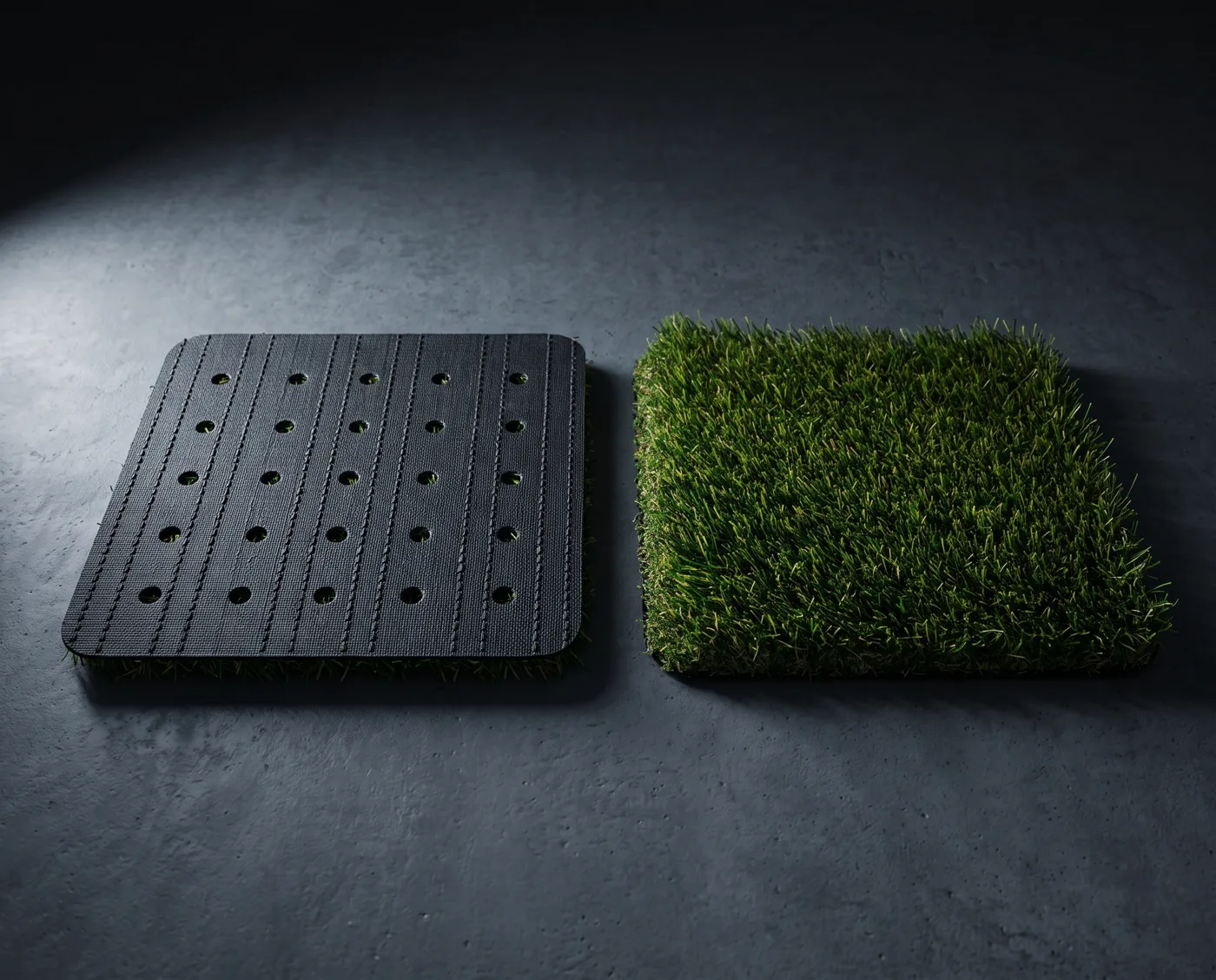
The three backing systems compared
| Backing | How it drains | Strengths | Watch for |
|---|---|---|---|
| Polyurethane (PU) coated | Punched holes, rows a few inches apart | Dimensional stability, handles SoCal heat, long fiber lock | Costs more, standard hole drainage only |
| Latex coated | Punched holes | Cheapest to make | Can dry out, crack, and shed fibers faster in hot climates |
| Fully permeable | Entire backing surface drains | Best for pet turf and high-rain drainage | Newer category, verify the drainage rate claim on the spec sheet |
Backing failure looks like this: fibers pulling out in traffic lanes, seams opening, panels shrinking or curling at the edges, and pet areas that hold odor because water sits. The turf face gets the blame, but the backing was the failure. It is the third spec in our seven-spec supplier checklist for a reason.
What to check on the spec sheet
Three lines: the secondary coating material (PU on everything Mighty Turf stocks), the drainage rate (stated in inches per hour, not adjectives), and tuft bind (the force needed to pull a fiber out, higher is better). A supplier who cannot produce those three numbers is selling you a photo of grass. Every line we carry publishes them, next to total weight, face weight and pile height, on the product spec sheets.
Frequently Asked Questions
What is the best backing for artificial turf?
Polyurethane-coated backing for most uses: it holds tuft bind longer and handles heat and moisture better than latex. For pet-heavy installs, a fully permeable backing drains across its whole surface and controls odor best.
Why does turf backing matter more in Southern California?
Heat. Latex backings dry out and get brittle faster under sustained high temperatures, which shows up as fiber shedding and edge curl years before the face wears out. PU backing handles the climate.
How does water drain through artificial turf?
Standard backing drains through punched holes, typically handling around 30 or more inches of rain per hour into the base below. Fully permeable backings drain through the entire surface, several times faster, which matters for pet urine and heavy storms.
SourcesSynthetic Turf Council
Price Your Next Job.
Get wholesale pricing, full spec sheets, and a free sample factory-direct. No large minimums.
Or call 888-9-MIGHTY